The 2026 AI Coding Rate-Limit Report
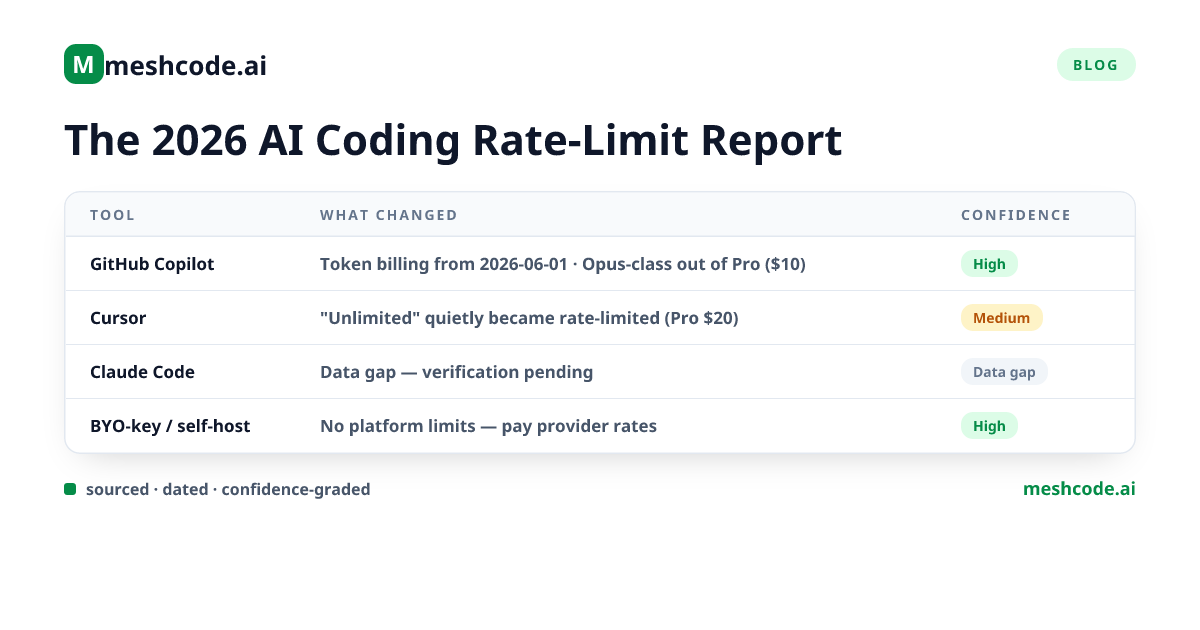
Copilot moved to token billing on 2026-06-01 — Pro ($10) lost Opus-class access. Cursor's "unlimited" became rate limits. Every figure sourced, dated, graded.
 Dana Cho · Product Engineer · September 17, 2026 · 6 min read
Verdict (above the fold)
Across 2025–2026, every major AI coding tool moved from subsidized flat-rate pricing toward token-based billing with tighter rate limits. The trigger isn't model quality — it's inference cost. For developers, the visible symptoms are three: hidden usage, surprise lockouts, unpredictable bills. This page compiles what changed, when, and what it costs — with sources.
Connect the Claude or Codex you already pay for — the rest runs on workers that cost a fraction.
Download meshcode →What we measured
Comparison axes were fixed in advance to our own criteria — we deliberately did not adopt vendors' published feature frames:
- Usage / rate-limit transparency
- Billing model
- Mid-workflow lockout risk
- Frontier-model access at base price
- Data / privacy posture
- Self-host / BYO-key
The data
GitHub Copilot
| Item | What changed | Source | Verified | Confidence |
|---|---|---|---|---|
| Billing model | premium-request → token billing (AI Credit = $0.01), effective 2026-06-01 | benday.com/copilot-billing-2026-update | 2026-09-17 | High |
| Plan limits | Pro $10/mo = $15 credits · Pro+ $39 = $70 · Max $100 = $200 (new tier) | benday.com | 2026-09-17 | High |
| Frontier access | Opus-class removed from Pro ($10); requires Pro+ ($39)+ | benday.com | 2026-09-17 | High |
| Lockout behavior | No more silent fallback to cheaper models — when credits run out, work stops | benday.com | 2026-09-17 | High |
| Cost pressure | Weekly cost of running Copilot ~doubled since Jan 2026; leaked docs show planned signup pauses + tighter limits | wheresyoured.at | 2026-04-20 (report date) | Medium (single-source leak; MS confirmed some details) |
| Reported impact | 82% of monthly allowance gone on day one · half of allowance on 8 requests · one user's $39 month estimated at ~$6,000 | benday.com / davep.org (citing GitHub Community + Reddit) | 2026-09-17 | Medium (user-reported) |
| Transparency gap | Rate-limit errors show a literal <duration> placeholder; GitHub says better usage visibility is still "in development" |
blog.davep.org (series) | 2026-03 | High (first-hand) |
Cursor
| Item | What changed | Source | Verified | Confidence |
|---|---|---|---|---|
| "Unlimited" walkback | Pro ($20) "Unlimited Agent Requests" quietly changed to rate-limited (~2025-06-16); description moved to "Extended limits on agent" | consumerrights.wiki (cites Cursor pricing-page archives) | 2026-09-17 | Medium (community wiki, flagged "needs additional work"; direction corroborated by Cursor's own blog) |
| Limit mechanics | "$20+ of model inference" allowance; resets described as "5–24 hours," best-effort | consumerrights.wiki / forum.cursor.com | 2026-09-17 | Medium |
| Reported lockouts | Users report lockouts after ~3–7 requests; isolated reports of ~26-hour lockouts; no usage dashboard | consumerrights.wiki (user reports) | 2026-09-17 | Low–Medium (user-reported) |
| Official response | Cursor (2025-07-05) admitted "unlimited usage" was misleading; Pro ≈ 225 Sonnet-4 requests/month | Cursor blog "Clarifying June 16 Pro Changes" (via consumerrights.wiki + forum.cursor.com) | 2025-07 | High (vendor statement) |
| Community demand | Forum feature request for a Pro rate-limit meter (28 replies); "limits applied inconsistently" thread (4,459 views) | forum.cursor.com | 2026-09-17 | High (observed) |
Anthropic / Claude Code
| Item | What changed | Source | Verified | Confidence |
|---|---|---|---|---|
| Billing direction | Anthropic moving enterprise users toward token-based billing | wheresyoured.at (citing The Information) | 2026-04-20 | Medium (second-hand) |
| Claude Code plans/limits | Not yet verified in this report — official pricing-page review pending | — | — | ⚠️ Data gap |
Open-source / BYO-key (opencode lineage)
| Item | Status | Confidence |
|---|---|---|
| Rate limits | No platform-imposed limits — you pay the model provider directly (BYO-key) | High (structural) |
| Billing | Token cost at provider rates, no platform markup | High |
| Plan rug-pull risk | None — self-hostable; no vendor can unilaterally change your terms | High (structural) |
Warp
⚠️ Data gap — Warp (the agentic terminal, warp.dev) rate limits/pricing are not yet verified in this report. (Note: "WARP" search results are dominated by Cloudflare's unrelated VPN product; this needs a targeted source review.)
The pattern
Read together, the data points one direction: subsidized compute is ending, and every incumbent is passing inference cost to users through tighter limits and token billing. The symptoms developers report — hidden usage, surprise lockouts, unpredictable bills — are downstream of that single shift. Nobody is losing because the models got worse; they're losing because the economics changed and the usage became invisible.
Why we built meshcode against this
(Transparency, not a pitch.) We're meshcode, an open-source-lineage AI coding agent. We publish our usage metering, support bring-your-own-key (self-host or hosted), and impose no platform rate limits — because the data above is what happens when usage is hidden. If these numbers are useful, link them; that's what they're for.
- See the metering → meshcode.ai
- Self-host / BYO-key guide → Bring your own API key to an AI coding app
- Correct or extend this data → meshcode.ai/founder
Methodology & honesty notes
- Comparison axes were fixed in advance to our own criteria (transparency, cost, lockout) — not vendors' published feature frames.
- Every figure carries a source and a verification date. Confidence is graded:
- High = official vendor statement or first-hand documentation
- Medium = single-source reporting or corroborated community wiki
- Low = individual user reports
- Some Cursor/Copilot impact numbers are user-reported and marked as such. We did not promote any vendor's marketing copy into fact.
- Known gaps: Claude Code and Warp plan/limit specifics are pending targeted review. This page will be updated as those are verified.
- Last updated: 2026-09-17. Published by meshcode. Corrections welcome via meshcode.ai/founder.
Suggested citation
meshcode, The 2026 AI Coding Rate-Limit Report, 2026-09-17.
meshcode.ai/blog/cursor-copilot-rate-limits-2026
More from the blog
No-Code vs. Learning to Code in 2026
A balanced, honest look at no-code vs. learning to code in 2026, so you can pick the path that actually gets you the software you need.
 Marcus Webb
How to Run Claude Code and Codex in Parallel on One Repo (Git Worktrees, Step by Step)
Run Claude Code and Codex on the same repository at once without them overwriting each other: one git worktree per agent, scoped briefs, and a safe merge. Step by step.
 Sofia Reyes
The Cheapest Way to Use Grok for Coding in 2026
The cheapest way to use Grok for coding depends on how you work: API tokens from about $1 per million, Cursor Pro at $20 with a dedicated Grok pool, or SuperGrok at about $30. What each route really costs.
Sofia Reyes